

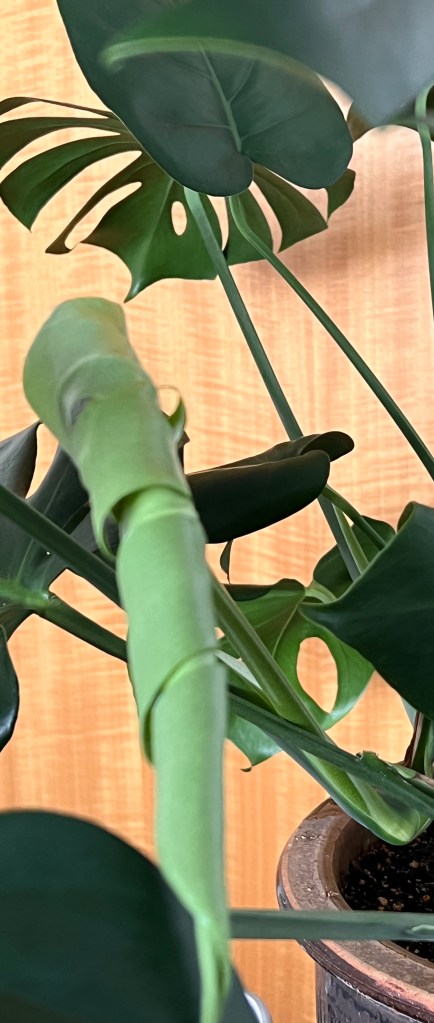
Over the past two weeks, Mike Wazowski, the Monstera deliciosa (get it??) in my office, has been growing a new leaf. One day, there was nothing. Then, as if magically and overnight, there was a long, narrow spike resembling a delicate green chrysalis.
I’ve watched, day by day, as that spike lengthened, a fleshy stalk appearing, then the veining and outline of the coiled leaf, its pale green brightening first into vibrant chartreuse, then a deepening rich emerald.
I know, from watching this process happening over and over, that eventually that tight whorl will begin to loosen, first at the edges, unwinding day by day, stretching, opening. Its patterns will emerge — the array and patterns of fenestrations and lobes unique to each leaf. When it’s fully unfurled, the leaf may span broader and longer than my outstretched hands, and that verdant emerald will settle into a deep, waxy forest hue.
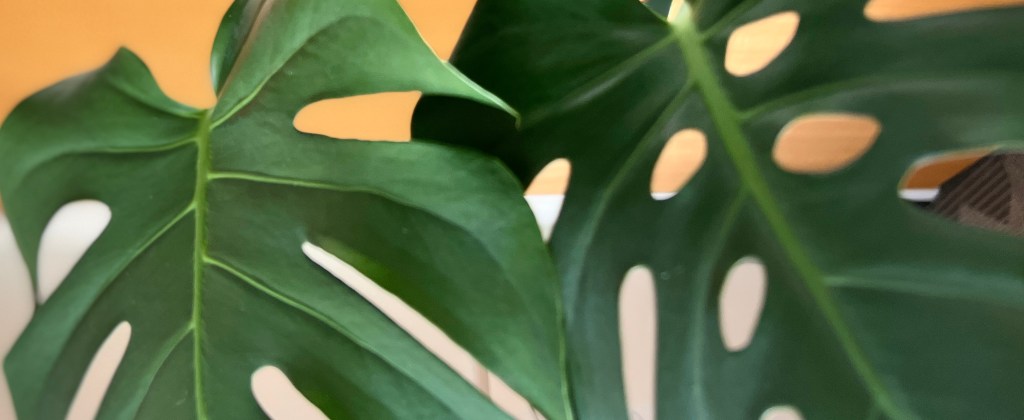
I feel a giddy sense of appreciation each time, because when I found Mike in the floral department of a grocery store six months back or so, he was a runty little thing. His half-dozen leaves were small, dull and pale, soil dry and cracked. He had apparently arrived a little worse the wear from transit, and was heavily discounted. And as I discovered when I got him home, he was severely root-bound.
Now, Mike is flourishing in his little corner of my office. I water him religiously (not too much, because I worry about root rot), and every weekend he moves to the slightly sunnier room at the end of the hall for a little more direct sunlight — I figure if I get to go home and replenish myself for two days, he deserves a little TLC too. And he’s big — already crowding the large pot I settled him in, new leaves easily eclipsing the size of those six ragged leaves he arrived with, shiny and bright and rich.
But every vivid new spike gives me pause and wonder, all over again. How big will this one be? What pattern will its splits take?
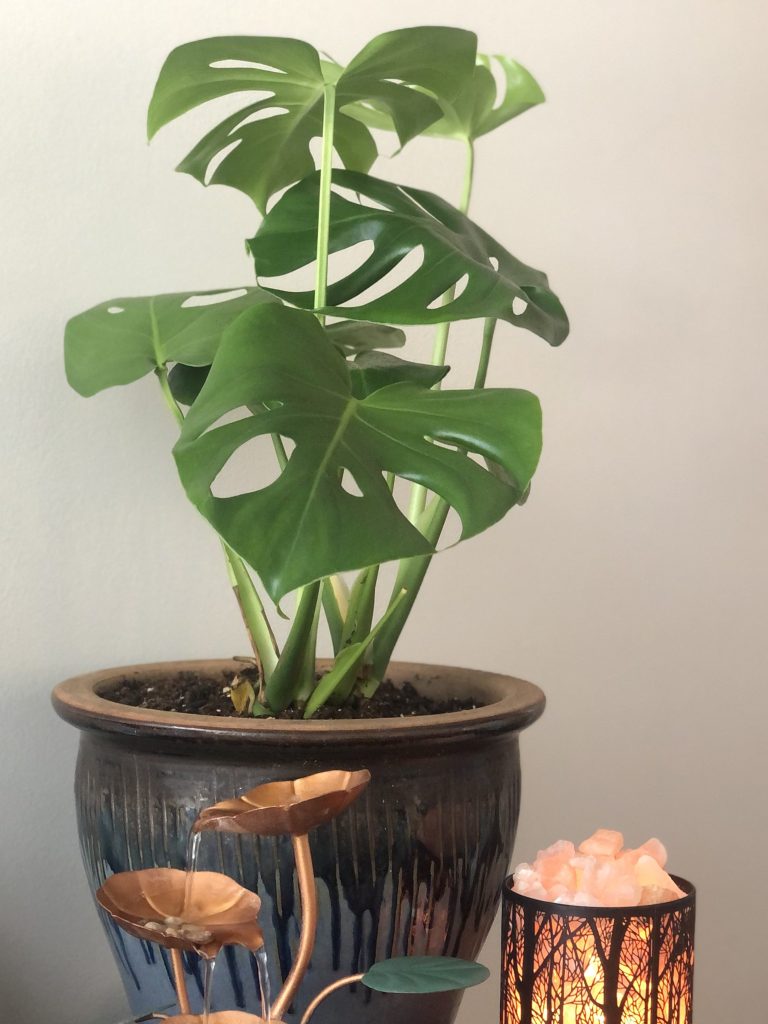
And each time, there’s a little impatience to my excitement. Mike’s leaves take, on average, two to three weeks to fully open. I always want to hurry the process along, gently tease at that tight whorl to expose Mike’s newest development, to help him out.
But I don’t. The leaf is not ready. It may look finished, but it’s still delicate. If I pry it open I might damage it, stunting its growth, deforming it. And so I wait, letting that leaf unfurl on its own. I’m doing my part by keeping Mike nourished and making sure he has the conditions he needs — water, but not too much; sunlight, but not too much, a bit of humidity — to flourish. I can help, but I can’t force the process.
I’ve done what I can. I’ve transplanted and cared for Mike, and these new leaves will emerge and blossom open at their own pace. And leaf by leaf, over months and years, he’ll fill out, he’ll climb, he’ll slowly come to no longer resemble that stunted, malnourished sprout I brought home — so long as I continue to provide the environment he needs to thrive without trying to rush along his process.
*
The other day I was talking to someone very dear to me who has recently made some radical changes in her own life — realizing she needed more to thrive. She transplanted herself, as it were, and she’s ready — impatient — to see new growth.
And in our conversation, we kept circling back to this: when would it happen? When would all the pieces she threw in the air fall together into a new, beautiful order?
I could sense that she was a little like me and Mike Wazowski: she’d sorted out the watering, sunlight, and humidity; she’d created the environment needed to foster that new growth. And as those signs of new life began appearing, shiny and fresh, she was excited and impatient to see what patterns these new leaves had in store for her.
She was tempted to pull at them, help them unwind a little faster.
It’s human nature to desire growth and change. It’s healthy. And we can certainly take steps to catalyze that change, create the space for ourselves to grow and thrive.
We can mindfully and reflectively sit with ourselves, analyzing our instincts and impulses, teasing out the patterns of our past decisions. Whether on our own or with the help of trusted family, friends or a therapist, we can recognize where we create our own barriers, and consciously let go of or re-shape our narratives. We can step outside of our comfort zones, take leaps (or even baby steps) of faith into positive new directions. We can clear a space (whether mentally, emotionally, and/or physically) for that new growth, prep and tend to the soil, carefully cultivate the right environment, and plant the seeds.
When we’ve got the conditions right, growth will follow. But we have to be patient.
I read somewhere that a Monstera deliciosa leaf can take anywhere between a week and two months to fully develop. Monsteras are complex, large plants — a fully-developed, healthy leaf on a mature plant can be nearly a foot long and wide, the leaves themselves thick and waxy. Organization and growth on that scale is going to take some time. It’s going to take a lot of resources and energy.
But for all the wondrous complexity of my Monstera, we are moreso by many factors. So it’s going to take some time, and we have to let that growth unfurl as it will.
That’s not our work. Our work — the work of all work, I would argue — firstly is painstaking cultivation of that nourishing environment. That itself is no small feat, if less glamorous and immediately gratifying than seeing those shiny new leaves taking form. And secondly, it’s to nurture, tend to, encourage and support — in an appreciative, loving, and patient manner — what may unfurl at its own readiness.

 Last Turn to the Right
Leave a comment